
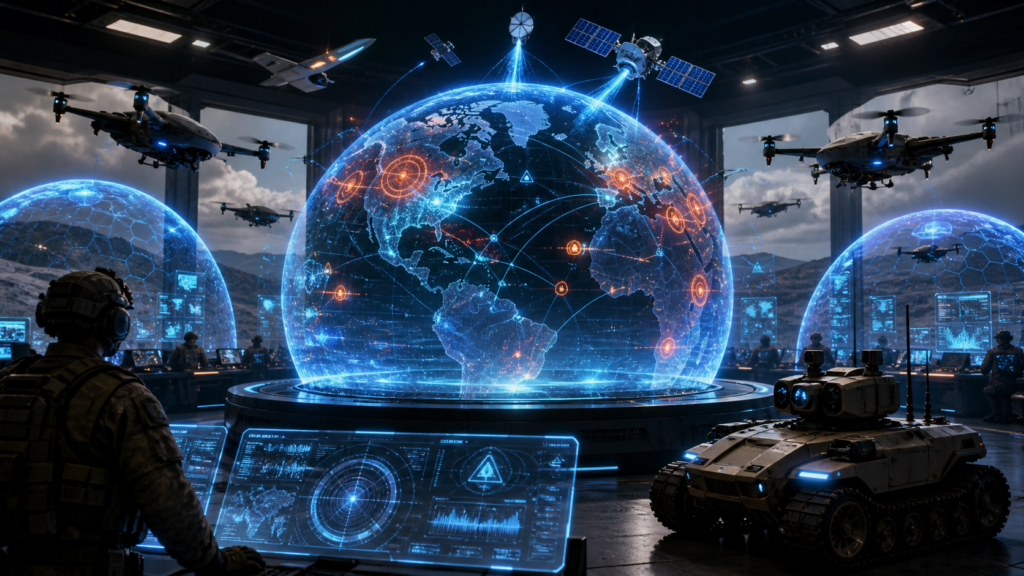
Key Highlights
- Modern defense systems now include software, AI, and autonomous platforms, not just traditional hardware.
- Artificial intelligence is transforming military operations by improving decision-making, automating surveillance, and enabling autonomous systems.
- The defense technology landscape includes both established contractors and innovative, venture-backed tech companies.
- Key categories shaping modern defense include autonomous systems, AI, cyber defense, secure communications, and space systems.
- Advanced defense technology is crucial for national security, offering enhanced situational awareness and a strategic edge.
Introduction
Defense technology is changing faster than traditional procurement cycles were designed to handle. AI, autonomy, space systems, cyber defense, secure communications, sensors, and software-defined platforms are reshaping how governments, contractors, and startups think about national security. These advanced defense systems are not just about aircraft and ships anymore; they encompass a vast digital ecosystem. This guide provides a complete overview of what defense technology systems are, the categories that matter, who the key providers are, and how to evaluate them.
Understanding Defense Technology Systems in the Modern Era
Defense technology systems represent a major shift in how nations approach modern warfare and national security. It’s no longer just about building bigger and faster machines. Today, the focus is on smarter, more connected, and highly adaptable defense systems that leverage software, data, and artificial intelligence to create a decisive advantage in military operations.
This new era is defined by a diverse range of players, from massive, long-standing defense contractors to agile startups entering the defense sector. These companies are developing solutions that enhance everything from battlefield awareness to logistical efficiency. We will explore the core components of these systems, how they differ from legacy platforms, and their critical role in safeguarding national security.
Defining Defense Technology Systems and Their Core Components
At its core, a defense technology system is an integrated set of tools, platforms, and software designed to support military objectives. Unlike a standalone piece of hardware, these systems combine various core components to deliver a comprehensive capability. Think of them as the central nervous system of modern military forces, connecting sensors, operators, and platforms in a cohesive network.
The primary components often include hardware like sensors, drones, and communication devices. However, the true power lies in the software that drives them. This includes artificial intelligence algorithms for data analysis, command and control (C2) software for decision-making, and secure networks that ensure information is shared reliably and safely.
Ultimately, the goal of these integrated military technologies is to achieve superior situational awareness. By fusing data from multiple sources—from satellites in space to sensors on the ground—these systems provide commanders with a clear, real-time picture of the operational environment, enabling faster and more effective decisions.
How Defense Technology Systems Differ from Legacy Military Platforms
The distinction between modern defense technology systems and legacy military platforms is fundamental. Legacy platforms, such as traditional fighter jets or tanks, were primarily defined by their physical hardware—speed, armor, and firepower. Their capabilities were largely fixed at the time of manufacturing. Updates were infrequent, expensive, and required significant physical modifications.
In contrast, modern defense solutions are software-defined. Their capabilities can be updated rapidly through software patches and algorithm improvements, much like a smartphone. This allows for continuous evolution and adaptation to new threats without needing to build a new platform from scratch. This software-centric approach is a hallmark of modern warfare, where adaptability is key.
This shift means that the value is no longer just in the steel, but in the code. A drone’s effectiveness, for example, depends as much on its autonomous navigation software and sensor data processing as it does on its airframe. This focus on adaptable, upgradable software is what sets today’s systems apart from the rigid, hardware-focused platforms of the past.
The Importance of Defense Technology for U.S. National Security
The adoption of advanced defense technology is not just an option; it is a necessity for maintaining U.S. national security. In an era of increasing geopolitical competition, technological superiority provides a critical strategic advantage. These systems enable the armed forces to deter adversaries, respond to crises, and protect national interests more effectively.
By enhancing military capabilities across all domains—air, land, sea, space, and cyberspace—defense technology acts as a force multiplier. For example, AI-powered intelligence systems can process vast amounts of data to identify potential threats before they materialize. Autonomous systems can perform dangerous missions, reducing risk to human personnel. These advancements allow the U.S. to project power and maintain stability without putting service members in unnecessary harm.
Ultimately, investing in the defense sector and its technological advancement is about future-proofing the nation’s defense posture. As adversaries develop their own advanced capabilities, the U.S. must continue to innovate to maintain its edge. This commitment to defense technology ensures that the nation is prepared for the challenges of today and the uncertain threats of tomorrow.
Main Categories of Defense Technology Systems
The world of defense technology systems is vast and complex, but it can be broken down into several key categories that are shaping the modern battlefield. These categories represent the core areas of innovation where both governments and private companies are focusing their investments. From intelligent autonomous systems to impenetrable cyber defenses, each category plays a unique role in building a comprehensive defense posture.
Understanding these primary domains is essential for anyone looking to grasp the current state of military technologies. The following sections will provide a closer look at some of the most impactful categories: autonomous defense systems, AI-driven command and control, and the critical triad of cyber defense, secure communications, and electronic warfare.
Autonomous Defense Systems and Unmanned Platforms
Autonomous systems and unmanned platforms are at the forefront of the transformation in military operations. These technologies remove the human from direct harm, allowing defense forces to conduct missions in high-risk environments with greater safety and persistence. This category includes a wide array of military robotics, from aerial drones to unmanned ground and underwater vehicles.
The key innovation here is the increasing level of autonomy. Early unmanned platforms were remotely piloted, but modern autonomous systems use AI to navigate, collect data, and even make decisions without constant human input. This reduces the cognitive load on operators and enables new tactics, such as swarms of coordinated autonomous vehicles.
These platforms are used for a variety of missions, including:
- Intelligence, Surveillance, and Reconnaissance (ISR): Drones can loiter over an area for hours or days, providing continuous surveillance.
- Logistics: Autonomous vehicles are being developed to deliver supplies to front-line troops, reducing the risk to convoys.
- EOD: Robots are commonly used for explosive ordnance disposal, a task too dangerous for human soldiers.
AI Defense Systems, Battlefield AI, and Command-and-Control (C2) Solutions
Artificial intelligence is the engine driving many of the most significant advances in defense technology. AI defense systems are designed to augment human decision-making, automate complex tasks, and dramatically increase battlefield efficiency. This is particularly true in the realm of Command and Control (C2), where information overload is a constant challenge.
Battlefield AI uses machine learning algorithms to analyze data from thousands of sensors in real time. It can identify patterns, predict enemy movements, and recommend courses of action far faster than a human could. This provides commanders with unparalleled situational awareness, allowing them to understand and react to a complex, fast-moving environment.
Modern C2 solutions are essentially AI-powered software platforms that integrate data from across the battlespace into a single, coherent picture. Instead of manually piecing together reports from different units, commanders can see a unified, live view of their forces, the enemy, and the operational environment. This ability to process information and make decisions at speed is a critical advantage in modern conflict.
Cyber Defense, Secure Communications, and Electronic Warfare
As warfare becomes increasingly digital, the domains of cyber defense, secure communications, and electronic warfare have become critically important. These defense applications are focused on controlling the electromagnetic spectrum and securing the networks that all other modern military systems rely on. A failure in this area can render even the most advanced weapons useless.
Digital warfare involves both defending friendly networks and disrupting enemy systems. This includes a range of activities from protecting command centers from cyberattacks to jamming enemy communications. The key challenge is to maintain secure communications for your own forces while denying the same to your adversary.
The main pillars of this category are:
- Cyber Defense: Protecting networks, data, and systems from intrusion, disruption, and espionage.
- Electronic Warfare (EW): Using the electromagnetic spectrum to sense, protect, and communicate, as well as to deny adversaries the ability to do the same. It is a constant battle for control over signals intelligence.
Key Innovation Drivers in Defense Tech
Several powerful forces are driving the rapid pace of innovation in defense technology. The convergence of commercial technological breakthroughs and new strategic imperatives has created a fertile ground for change within the defense industry. This isn’t just about incremental improvements; it’s about fundamental shifts in how military operations are conceived and executed.
We are witnessing a period where the speed of technological change is outstripping traditional defense procurement models, forcing a reevaluation of how innovation is sourced and integrated. The following sections will explore three of the most significant drivers: the transformative impact of AI infrastructure, the strategic importance of dual-use technology, and the latest trends in sensors and space systems.
The Influence of AI Infrastructure on Modern Defense
The rise of artificial intelligence in military operations is not just about clever algorithms; it depends entirely on a robust and scalable AI infrastructure. This underlying framework of hardware, software, and data pipelines is what allows machine learning models to be trained, deployed, and managed effectively across the defense enterprise. Without it, even the most advanced AI is just a concept.
A modern AI infrastructure provides the computational power needed to process the massive datasets generated by military sensors. It enables the development and refinement of models for a huge range of applications, from predictive maintenance on aircraft engines to real-time target recognition in satellite imagery. This infrastructure is the backbone of battlefield AI.
Furthermore, a well-designed AI infrastructure ensures that these powerful tools can be deployed securely and reliably, from cloud data centers to devices on the tactical edge. This ability to run AI anywhere is critical for national security, as it allows forces to leverage advanced analytics and automation even in disconnected and contested environments.
The Role of Dual-Use Technology in National Security
Dual-use technology refers to technologies that have both commercial and military applications. This concept has become a central driver of innovation in the defense sector. Many of the most transformative technologies today—such as AI, robotics, and advanced computing—originated or were perfected in the private sector for commercial purposes.
The strategic importance of dual-use technology is that it allows the defense establishment to tap into the massive research and development ecosystem of the commercial tech world. Instead of developing every capability from scratch, the Department of Defense can adapt and integrate cutting-edge commercial products, saving time and money while accelerating innovation.
This approach fosters a closer relationship between the private sector and national security organizations. Companies that traditionally did not see themselves as part of the defense industry are now providing critical capabilities. This infusion of commercial innovation is vital for maintaining a technological edge and addressing emerging threats with agility.
Trends in Sensors, ISR, and Space Systems
The ability to see, sense, and understand the battlefield is fundamental to any military operation. The latest trends in sensors, Intelligence, Surveillance, and Reconnaissance (ISR), and space systems are all geared towards providing a more complete and persistent picture of the globe. This drive for ubiquitous situational awareness is creating a revolution in military intelligence.
Sensors are becoming smaller, cheaper, and more interconnected, creating a vast network of IoT devices on the battlefield. These sensors can be deployed on everything from soldiers and vehicles to disposable drones, gathering data from every corner of the operational environment. This proliferation of data sources creates both an opportunity and a challenge.
Key trends in this area include:
- Commercial Space: The explosion of commercial satellite constellations is providing unprecedented access to high-resolution earth imagery and global communications.
- Sensor Fusion: AI algorithms are being used to fuse data from multiple types of sensors (e.g., optical, radar, thermal) to create a richer, more accurate intelligence product.
- Edge Processing: Pushing data processing capabilities to the sensors themselves allows for faster analysis and reduces the amount of data that needs to be transmitted back to command centers.
Leading Types of Providers in Defense Technology
The defense technology landscape is populated by a diverse ecosystem of providers, each playing a distinct role. The industry is no longer dominated solely by a handful of prime contractors. A new generation of tech-focused companies has emerged, challenging old business models and accelerating the pace of innovation within the defense sector.
Understanding the different types of providers is key to navigating this complex market. From massive system integrators with deep government ties to nimble startups backed by venture capital, the source of innovation is more varied than ever. We will now look at the three main categories of organizations building the future of defense: established contractors, venture-backed tech companies, and government-led innovation entities.
Established Defense Contractors and System Integrators
Established defense contractors are the traditional giants of the defense sector. These companies, often referred to as «primes,» have long-standing relationships with the Department of Defense and are experts at managing large, complex, multi-decade programs of record. They excel as system integrators, bringing together components from vast supply chains to build everything from fighter jets to aircraft carriers.
Their strength lies in their scale, their deep understanding of government procurement, and their ability to manufacture and sustain complex hardware platforms. They are the backbone of the traditional defense industrial base and are responsible for producing the majority of the military’s current equipment.
However, these large organizations can sometimes struggle with the rapid pace of software development and digital innovation. Their business models are often built around long, hardware-centric production cycles.
| Contractor Type | Key Characteristics |
|---|---|
| Prime Defense Contractors | Manage large-scale government programs, act as system integrators, and have deep expertise in hardware manufacturing and sustainment. |
| System Integrators | Focus on combining various subsystems and components from different vendors into a single, functioning system for the customer. |
Venture-Backed Defense Tech Companies and Startups
A new and dynamic force in the defense industry is the rise of venture-backed defense startups. These companies are built on a different model than traditional contractors. They are funded by private sector investment, staffed by talent from the commercial tech world, and focused on rapid product development and software-driven innovation.
These tech companies are often founded with the specific goal of bringing Silicon Valley’s agile development methodologies to the defense sector. They specialize in areas like artificial intelligence, autonomy, and data analytics, building software-centric products that can be updated and improved continuously. They aim to deliver cutting-edge capabilities to the warfighter on much faster timelines than traditional procurement allows.
While they may not have the manufacturing scale or program management experience of the primes, these defense startups are a vital source of disruption and innovation. They challenge the status quo, introduce new business models, and push the entire defense industry to move faster and be more adaptable.
Government Agencies, Research Labs, and the Role of the Defense Innovation Unit (DIU)
Beyond private industry, government agencies and research labs are a crucial part of the defense innovation ecosystem. Organizations like the Defense Advanced Research Projects Agency (DARPA) and various service-specific research laboratories are responsible for long-range, high-risk research that pushes the boundaries of science and technology. They plant the seeds for future military capabilities.
In recent years, the Department of Defense has also recognized the need to bridge the gap between government needs and commercial innovation. This led to the creation of defense organizations like the Defense Innovation Unit (DIU). The DIU’s specific mission is to accelerate the adoption of commercial technology by the U.S. military to solve critical national security problems.
The DIU acts as a gateway for commercial tech companies, especially those that have not traditionally worked with the government. It uses fast, flexible contracting methods to move from problem to prototype in months, not years. By connecting commercial innovators with military users, the DIU helps to pull cutting-edge technology into the hands of the warfighter much more quickly.
Profiles of Top Defense Technology Companies in the United States
The United States is home to a vibrant and diverse collection of defense technology companies, ranging from century-old industrial giants to brand-new startups. These top providers are developing the advanced defense solutions that are fundamental to the nation’s national security strategy. Understanding who these key players are provides insight into the direction of the industry.
This section will profile some of the most influential defense companies in the U.S. market. We will look at both the emerging leaders who are disrupting the industry with software and AI, as well as the established players who are adapting their massive scale to the new realities of modern defense.
Anduril Industries, Shield AI, and Emerging U.S. Leaders
Among the new wave of defense startups, Anduril Industries and Shield AI have emerged as prominent leaders. These companies exemplify the venture-backed, software-first approach to defense. Anduril Industries focuses on building AI-powered hardware and software for a range of defense applications, from counter-drone systems to autonomous underwater vehicles, all integrated through its Lattice OS software platform.
Similarly, Shield AI is dedicated to making AI the pilot. Its Hivemind AI pilot can fly aircraft, from small drones to fighter jets, autonomously in complex and contested environments. The company’s mission is to enable autonomous swarms and protect service members by removing them from harm’s way. Both Shield AI and Anduril Industries are pioneering new ways of developing and deploying defense technology.
These emerging leaders are proving that defense startups can build and deliver complex systems at scale. They are attracting top tech talent to the national security space and are forcing the entire industry to rethink how technology is built, sold, and used in defense. Their success is paving the way for a new generation of companies focused on solving critical defense challenges.
Palantir, RTX (Raytheon), Leidos, Kratos, and AeroVironment
Alongside the startups, several established and mid-tier companies are key players in the defense technology space. Palantir is a software company that has successfully bridged the gap between commercial and government markets, providing powerful data analytics platforms used extensively across the defense and intelligence communities. Its software helps organizations make sense of vast, complex datasets.
Legacy giants like RTX (formerly Raytheon Technologies) remain dominant forces, bringing immense scale in manufacturing sensors, missiles, and cyber defense systems. Leidos is a major system integrator and services provider, deeply embedded in government IT and logistics. Kratos has carved out a niche in affordable, high-performance unmanned aerial systems and space communications.
Finally, AeroVironment has long been a leader in small unmanned aerial systems, providing tactical drones used by soldiers around the world. Each of these companies occupies a different part of the defense sector, from pure software to specialized hardware, illustrating the diversity of providers needed to equip a modern military.
Differentiating Technology Providers vs. Defense Suppliers
In the complex defense industry, it’s important to distinguish between technology providers and traditional defense suppliers. While the terms are sometimes used interchangeably, they represent different roles and business models within the vast supply chains of the defense sector. A defense supplier might provide raw materials or basic components, whereas a technology provider offers a more advanced capability.
This distinction is becoming more critical as software and advanced electronics become the defining features of military systems. Understanding the difference helps clarify who is building foundational technology versus who is assembling parts. The following sections will break down the roles of end-to-end system integrators versus component vendors and outline key criteria for evaluating them.
End-to-End System Integrators vs. Component Vendors
The defense industry relies on a tiered structure of providers. At the top are end-to-end system integrators. These are typically the prime contractors who are responsible for delivering a complete, functioning system to the government. They manage the entire project, integrating hardware and software from hundreds or even thousands of subcontractors into a cohesive whole, like a new ship or aircraft.
Beneath them in the supply chains are the component vendors. These companies specialize in producing specific parts or subsystems. A component vendor might manufacture a specific microchip, a sensor, a motor, or a piece of software that becomes part of the larger system. They are experts in their niche but do not deliver the final, complete product to the end user.
The key differences are:
- System Integrators: Deliver a full, ready-to-use solution. They are responsible for making all the individual parts from different vendors work together.
- Component Vendors: Provide specialized parts or sub-assemblies. Their product is an input to another company’s integration process.
Evaluation Criteria for Selecting Defense Technology Providers
Selecting the right defense technology provider is a complex process with high stakes. The decision involves more than just comparing technical specifications; it requires a thorough assessment of a company’s capabilities, stability, and alignment with mission goals. Effective risk management during the procurement process is crucial to ensure a successful outcome.
When evaluating defense suppliers, government agencies and prime contractors consider a range of factors. For cutting-edge defense technology, the ability to innovate and adapt is just as important as a track record of reliability. The provider must demonstrate not only that their technology works but also that they can support, maintain, and upgrade it over its lifecycle.
Key evaluation criteria often include:
- Technical Performance: Does the technology meet or exceed the required specifications and performance benchmarks?
- Integration Capability: How easily can the technology be integrated with existing systems and platforms?
- Long-Term Viability: Is the company financially stable and likely to be able to support the product for years to come? This includes assessing supply chain resilience and the company’s business model.
Recent Advances and Emerging Trends in Defense Innovation
The field of defense innovation is in a constant state of flux, with new breakthroughs and emerging trends continually reshaping the landscape of military operations. Staying ahead of these changes is essential for maintaining national security. The current wave of innovation is characterized by the increasing autonomy of defense systems and the development of entirely new classes of capabilities.
From the rapid evolution of drones to the dawn of hypersonic and quantum technologies, the character of warfare is being redefined. These advancements promise to deliver unprecedented speed, precision, and intelligence. The following sections will explore some of the most significant recent advances and what they mean for the future of defense.
Evolution of Unmanned Systems and Counter-UAS Capabilities
Unmanned systems have evolved dramatically in recent years. What started as simple, remotely-piloted drones for surveillance has blossomed into a diverse family of sophisticated military robotics. Today’s unmanned systems operate across all domains—air, ground, and sea—and are increasingly capable of performing complex missions autonomously, from logistics and reconnaissance to direct combat.
This proliferation of drones has created a new and urgent challenge: the need for effective Counter-Unmanned Aircraft Systems (Counter-UAS or C-UAS). As drones become cheaper and more accessible, they can be used by adversaries and non-state actors to threaten military bases, critical infrastructure, and deployed forces.
Therefore, a major area of defense innovation is the development of autonomous defense systems designed to detect, track, identify, and neutralize hostile drones. This is a complex «cat and mouse» game, requiring a layered defense that combines radar, radio frequency detection, electro-optical sensors, and various methods to defeat the drone, from jamming to kinetic interceptors.
Next-Generation Hypersonics, Quantum Tech, and Defense Software Solutions
Looking toward the horizon, several emerging technologies are poised to have a revolutionary impact on defense. Hypersonics—weapons that travel at more than five times the speed of sound—are a top priority for the Pentagon. Their extreme speed and unpredictable flight paths make them incredibly difficult to defend against, creating a new strategic challenge.
Quantum tech is another area of intense research. Quantum computing promises to break current encryption standards and solve optimization problems that are impossible for today’s computers. Quantum sensing could enable the detection of stealth aircraft and submarines with unprecedented accuracy. While still in its early stages, the potential of quantum technology to shift the military balance is enormous.
Underpinning all of these advanced hardware platforms is the growing importance of defense software. The ability to rapidly develop, test, and deploy secure and resilient software is becoming the single most critical element of modern defense solutions. The next war may be won not by the side with the best hardware, but by the side with the best code.
Procurement, Integration, and Buyer Guidance
Acquiring and integrating new defense solutions into military operations is a notoriously difficult process. The traditional defense procurement system was designed for a different era, one of slow-moving, hardware-centric programs. Today’s fast-paced, software-driven world demands a more agile and flexible approach. For any organization in the defense sector, understanding this process is critical.
This section provides guidance for buyers and program managers navigating this complex landscape. We will cover the basics of defense procurement and government contracting, and then offer some best practices for assessing new technologies and managing the inherent risks involved in adopting cutting-edge capabilities.
Navigating Defense Procurement and Government Contracting
Navigating the world of defense procurement and government contracting can be daunting, especially for new entrants to the defense industry. The process is governed by a complex set of rules and regulations, designed to ensure fairness, transparency, and the responsible use of taxpayer money. However, this system can also be slow, bureaucratic, and risk-averse.
The Department of Defense has multiple pathways for acquiring technology. The traditional process involves a lengthy cycle of defining requirements, soliciting proposals, and awarding a contract, which can take years. Recognizing the need for speed, the DoD has also created several alternative, faster procurement vehicles, especially for software and commercial technologies.
Understanding these different pathways and engaging with the right program offices is key for any company looking to do business with the government. For government buyers, the challenge is to use these tools effectively to get capability into the hands of the warfighter at the speed of relevance, managing the intricate supply chains and timelines that define the process.
Best Practices for Defense Technology Assessment and Risk Management
A successful defense technology assessment goes beyond simply testing a new gadget. It requires a holistic approach that considers how the technology will fit into the broader military ecosystem, how it will be sustained over its life, and what new risks it might introduce. Effective risk management is central to ensuring that new systems enhance, rather than degrade, mission readiness.
One of the best practices is to involve end-users—the soldiers, sailors, and airmen who will actually use the technology—early and often in the assessment process. Their feedback is invaluable for understanding the real-world utility and potential challenges of a new system. This user-centric approach helps to ensure that the technology actually solves a real problem.
Another key practice is to focus on integration from day one. A piece of defense technology, no matter how advanced, is useless if it cannot communicate and share data with other systems. Rigorous testing of interfaces and data standards is essential. Finally, a thorough assessment must consider the full lifecycle cost, including training, maintenance, and future upgrades, to get a true picture of the investment required.
Conclusion
In conclusion, understanding defense technology systems is essential for grasping the evolving landscape of national security. As we’ve explored the various categories and key providers, it’s clear that the integration of advanced technologies such as AI, cyber defense, and autonomous systems is reshaping military capabilities and procurement processes. The collaboration between legacy contractors and emerging startups is vital in driving innovation and enhancing operational effectiveness. By prioritizing thorough evaluations of technology providers, stakeholders can ensure they are prepared for the challenges and opportunities that lie ahead. For a deeper dive into defense tech solutions tailored for your organization, don’t hesitate to reach out and explore how our expertise can assist you.
Frequently Asked Questions
What are the main challenges in adopting new defense technology systems?
The primary challenges include slow and complex procurement processes, difficulties integrating new systems with legacy platforms, and managing cybersecurity risks. Overcoming bureaucratic hurdles to foster rapid innovation adoption and ensuring new defense technology is reliable and effective in military operations are also significant obstacles in risk management.
How do companies become approved defense technology providers?
Companies typically become approved defense technology providers by successfully competing for contracts with the Department of Defense. The approval process often involves demonstrating technical capability, meeting stringent security and certification standards, and navigating the formal procurement system. Partnerships with established prime contractors can also provide a pathway.
What are the future growth areas for defense tech in the United States?
Future growth in U.S. defense tech will be concentrated in artificial intelligence, autonomous systems, cyber and space defense, and hypersonic weapons. Continued innovation in software-defined systems and data analytics will also be critical areas of investment to address evolving national security challenges and drive technological advancements.