
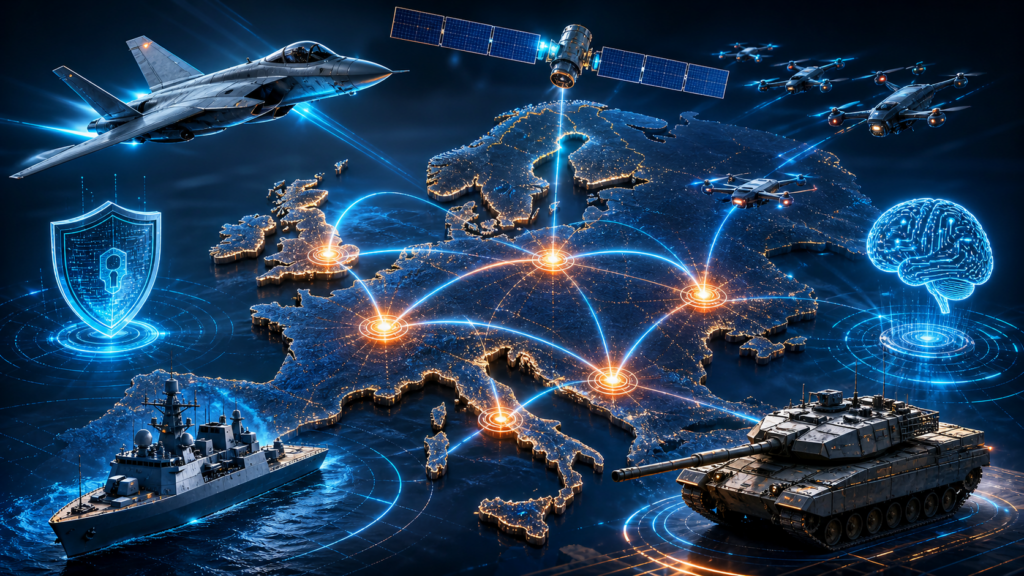
Key Highlights
Here are the key takeaways from the evolving European defense technology landscape:
- The european defence landscape is undergoing a significant transformation due to increased geopolitical risks and a renewed focus on strategic autonomy.
- Europe’s defence industry is a mix of large, established contractors and a growing number of innovative startups and SMEs.
- Funding initiatives like the European Defence Fund are becoming crucial for fostering cross-border collaboration and developing next-generation capabilities.
- There’s a strong push for greater strategic autonomy, reducing reliance on non-EU countries for critical defense technologies.
- Dual-use technologies, which have both civilian and military applications, are playing an increasingly important role in this new ecosystem.
Introduction
The european defence landscape is changing rapidly. Rising security concerns, modernization programs, and lessons from modern conflicts are pushing governments and companies across Europe to rethink how defense systems are developed, procured, and deployed. This shift is not just about traditional military hardware; it involves a surge in innovation, particularly from dual-use technology startups. The entire defence industry is adapting to a new reality, driven by a collective push for greater security and technological sovereignty. This guide will explore the key players, funding mechanisms, and technological trends shaping this dynamic sector.
Understanding the European Defense Technology Landscape
The european defence ecosystem is a complex web of established industry giants, innovative startups, and government-led initiatives. It’s a market in transition, moving from a fragmented collection of national industries towards a more integrated and collaborative model. This evolution is driven by shared security challenges and the political will to build a more resilient and self-sufficient European defence sector.
For years, the focus of many EU member states was on different priorities, leading to underinvestment in defense capabilities. Now, there is a clear and concerted effort to reverse this trend, creating new opportunities and challenges for companies operating in this space. We will now explore the specific definition of this market, its historical evolution, and its current supply chain dynamics.
Market Definition and Scope of Defense Tech Europe
The European defense technology market encompasses all activities related to the research, development, production, and maintenance of military equipment and services within the European Union and associated nations. This includes everything from large-scale platforms like fighter jets and naval vessels to advanced software, cyber defense solutions, and autonomous systems. It represents a significant portion of the continent’s industrial base.
A key trend shaping this landscape is the push for greater «strategic autonomy,» which aims to strengthen the EU’s ability to act independently in security and defense matters. This involves reducing reliance on non-EU suppliers for critical technologies and strengthening the European defence industry. The market is also heavily influenced by the policies and procurement decisions of individual member states, which often prioritize national champions.
This complex interplay between national interests and collective EU goals defines the market’s unique character. It’s a landscape where large, state-affiliated contractors coexist with a growing number of agile startups, all competing for a share of rapidly increasing defense budgets.
Evolution and Role of European Military Technology
The evolution of European military technology has historically been tied to the continent’s major conflicts and geopolitical shifts. From the Cold War arms race to the peace dividend that followed, the defense industry has always adapted to the prevailing security environment. Today, the demands of modern warfare, highlighted by recent conflicts, have accelerated the pace of innovation dramatically. There is a renewed emphasis on capabilities that offer information superiority and precision.
The traditional pillars of European defense, such as aerospace and naval shipbuilding, remain crucial. However, the focus is increasingly shifting towards digital technologies. Artificial intelligence (AI), for instance, is being integrated into command and control systems, intelligence analysis, and autonomous platforms to speed up decision-making. Quantum computing, while still in its early stages, promises to revolutionize secure communications and data processing, offering a significant future advantage.
This technological shift means that military equipment is becoming more sophisticated and software-defined. The role of military technology is no longer just about hardware; it’s about creating interconnected, data-driven systems that can operate effectively across air, land, sea, space, and cyberspace.
Industrial Dependencies and Supply Chain Dynamics
The European defense sector’s industrial base is broad, but it is not without its vulnerabilities. For decades, a fragmented market and a focus on cost-efficiency led to complex, globalized supply chains. This has created dependencies on non-European suppliers for certain raw materials, electronic components like semiconductors, and specialized sub-systems. These dependencies pose a significant risk to the security of supply, especially during times of crisis.
Ensuring resilient logistics and a reliable supply chain is now a top priority. The recent push to increase ammunition production, for example, has exposed bottlenecks in the supply of raw materials and the manufacturing capacity of the European industrial output. Governments and companies are now working to map these dependencies and invest in onshoring or friend-shoring critical production capabilities to mitigate these risks.
The goal is to build a more robust and self-sufficient defense ecosystem. This involves not only boosting production capacity but also diversifying suppliers, investing in domestic manufacturing, and fostering closer collaboration between prime contractors and the smaller companies that form the backbone of the supply chain.
Primary Drivers Transforming European Defense Tech
Several powerful forces are currently reshaping the European defense tech landscape. A deteriorating security environment has prompted a fundamental rethink of defense policy across the continent, leading to unprecedented increases in spending and a renewed focus on military readiness. This has created a surge in demand for new technologies and capabilities, energizing the entire defence industry.
At the same time, there is a strong political drive towards achieving strategic autonomy. This ambition is about more than just military power; it’s about ensuring Europe can secure its own interests and protect its citizens without being overly reliant on others. This push is strengthening the European defense industrial base and fostering a new era of innovation and collaboration. The following sections will look at these drivers in more detail.
EU and NATO Modernization Programs
Modernization is at the heart of the transformation in European defense. Both NATO and the European Union have launched ambitious programs to upgrade their military capabilities and ensure they can meet the challenges of the 21st century. For NATO, this means ensuring interoperability among allies and adapting to new threats in domains like cyber and space. Countries like France, Germany, and the UK are leading major national modernization efforts that align with these broader alliance goals.
The EU, through initiatives like the European Defence Fund, is incentivizing collaborative projects that pool resources and expertise from across the continent. This approach is designed to avoid duplication, achieve economies of scale, and develop cutting-edge technologies that no single country could afford on its own. These programs are not just about buying new equipment; they are about fostering a culture of innovation.
Countries such as Sweden and Finland, with their strong technology sectors, are also significant drivers of innovation, particularly in areas like secure communications and autonomous systems. This collaborative push for modernization is creating a more integrated and capable European defense posture, benefiting both the EU and the NATO alliance.
The Impact of Security Concerns and Defense Sovereignty
The shifting security landscape is arguably the most significant driver of change in European defense. The return of high-intensity conflict to the continent has served as a stark reminder that peace cannot be taken for granted. This has led to a political and public consensus on the need for stronger defense capabilities, resulting in historic increases in defense spending across nearly every European nation.
This renewed focus on security has thrust the concept of defense sovereignty into the spotlight. For many European governments, ensuring they have control over the technologies and industrial capabilities essential for their national security is now a paramount concern. This means reducing dependence on non-European suppliers for critical systems and components, from ammunition to advanced software.
This trend is reshaping the European defense sector, as governments increasingly prioritize domestic and European-made solutions. It is driving investment in local manufacturing, research and development, and the creation of more resilient supply chains. The pursuit of defense sovereignty is not about isolationism but about building a stronger, more self-reliant European pillar within the broader Western alliance.
The Growth of Dual-Use Technologies
One of the most exciting developments in European defense is the rapid growth of dual-use technologies. These are innovations developed in the commercial sector that also have powerful military applications. Think of artificial intelligence, satellite imagery, quantum computing, and advanced robotics. These technologies are blurring the lines between the civilian and defense industries.
This trend is opening up the traditionally closed defense market to a new generation of innovators, including agile startups and specialized small and medium-sized enterprises (SMEs). These companies are often more nimble and can innovate faster than the large, established defense contractors. They are bringing fresh ideas and cutting-edge solutions to stubborn military problems.
Startups are having a significant impact by introducing competition and accelerating the adoption of new technologies. They are particularly strong in software-defined areas like AI-powered intelligence analysis, autonomous drone navigation, and cybersecurity. Their involvement is making the European defense tech ecosystem more dynamic and resilient, injecting a new level of creativity and speed into the innovation cycle.
Key Players in European Defense Technology
The european defence industry features a mix of globally recognized legacy contractors and a vibrant, growing ecosystem of disruptive startups. The traditional players, often with deep ties to their national governments, continue to dominate in terms of size and defence revenues, producing the large-scale platforms that form the backbone of Europe’s armed forces.
However, the landscape is becoming more diverse. Across the member states, new companies are emerging, specializing in niche, high-tech areas that are critical for modern warfare. This section will introduce you to both the established giants and the rising stars that are defining the future of European defense technology.
Leading European Defense Companies (Airbus Defence and Space, BAE Systems, Leonardo, Thales, Rheinmetall, Saab, MBDA)
The European defense market is home to several world-leading companies. These prime contractors are responsible for some of the most complex and critical defense programs on the continent. Companies like Airbus Defence and Space lead in military aerospace, while BAE Systems is a major player in combat vehicles and electronic systems. Italy’s Leonardo has a strong portfolio in helicopters, naval systems, and defense electronics.
France’s Thales is a global leader in electronics, cybersecurity, and space technologies. Germany’s Rheinmetall is renowned for its armored vehicles and ammunition. Sweden’s Saab is famous for its Gripen fighter jet and advanced sensor systems, and the multi-national MBDA is Europe’s premier missile systems provider. These firms are key members of bodies like the Aerospace, Security and Defence Industries Association of Europe (ASD), which represents the sector’s interests.
Here is a quick overview of some of the top players for 2025: | Company | Country of Origin | Key Specializations | |—|—|—| | Thales | France | Defense Electronics, Cybersecurity, Aerospace | | Leonardo | Italy | Helicopters, Naval Systems, Unmanned Systems | | Airbus | European | Military Aircraft, Space Systems, Drones | | Rheinmetall | Germany | Armored Vehicles, Ammunition, Air Defense | | BAE Systems | United Kingdom | Combat Vehicles, Aircraft, Electronic Warfare | | Saab | Sweden | Fighter Jets, Sensor Systems, C2 | | MBDA | European (Multi-National) | Missile Systems, Air Defense |
Emerging Startups and Scale-Ups (Helsing, Quantum Systems, ARX Robotics, ICEYE, Tekever)
Beyond the established giants, a new wave of startups and scale-ups is bringing disruptive innovation to the European defense sector. These agile companies are focused on software, AI, and autonomous systems, developing capabilities that are rapidly becoming essential on the modern battlefield. They represent the new face of European defense tech innovation.
One of the most prominent is Helsing, a German-French company specializing in artificial intelligence for processing sensor data in real-time. Another is Germany’s Quantum Systems, which produces advanced unmanned aerial vehicles (UAVs) for surveillance and reconnaissance. Estonia’s ARX Robotics is developing unmanned ground vehicles for tasks like logistics and casualty evacuation, reducing risk to soldiers.
Other notable startups to watch include:
- ICEYE: A Finnish company that provides synthetic aperture radar (SAR) satellite imagery for persistent monitoring, regardless of weather conditions.
- Tekever: A Portuguese firm that offers drone-based maritime surveillance services.
- Baykar Technologies: A Turkish company that gained global recognition for its Bayraktar TB2 armed drones.
These companies are proving that innovation in defense is no longer the exclusive domain of large contractors.
Distinction Between Legacy Providers and New Entrants
There is a clear distinction between the legacy providers and the new entrants in the European defense market. The legacy contractors are masters of large-scale systems integration, with deep expertise in manufacturing complex hardware like ships, tanks, and planes. Their business models are built around long-term government contracts and rigorous certification processes.
In contrast, new entrants are often software-first companies. They bring a different culture of rapid iteration and agile development, more akin to Silicon Valley than a traditional defense firm. This focus on software is a key area of innovation, with companies like Helsing leading the charge in creating AI-powered defense software platforms. These firms are challenging the old ways of doing things.
The key differences can be summarized as follows:
- Focus: Legacy providers focus on hardware and large platforms, while new entrants focus on software, data, and AI.
- Speed: New entrants can often develop and deploy new capabilities much faster than their larger counterparts.
- Business Model: Legacy firms rely on long procurement cycles, while startups often use subscription or service-based models.
The future of European defense will likely involve closer collaboration between these two groups, combining the industrial might of the legacy players with the innovative spark of the new entrants.
European Defense Innovation Ecosystem & Funding Programs
Fueling the transformation of European defense is a growing ecosystem of funding and support programs designed to foster innovation. At the forefront of this effort is the European Defence Fund (EDF), a flagship EU initiative aimed at promoting collaborative research and development among member states.
These programs are not just about providing money; they are about creating connections, breaking down national silos, and building a more integrated European defense industrial base. They are designed to support projects from the research phase all the way to prototype development, ensuring that new ideas can mature into tangible capabilities for Europe’s armed forces. We’ll now examine some of the most important funding and innovation initiatives.
Role of the European Defence Fund and Defence Fund Initiatives
The European Defence Fund (EDF) is a cornerstone of the EU’s strategy to bolster its defense capabilities and industrial competitiveness. Its primary role is to co-finance collaborative, cross-border research and development projects. By requiring that projects involve companies from multiple member states, the EDF incentivizes cooperation and helps build integrated European supply chains. This fosters innovation by bringing together diverse expertise to tackle complex technological challenges.
The fund plays a crucial role in developing new technologies by de-risking investment, particularly for small and medium-sized enterprises (SMEs) that might otherwise struggle to fund ambitious R&D. It supports the entire development cycle, from cutting-edge research to the creation of prototypes in areas like AI, quantum technologies, and next-generation combat systems.
Complementing the EDF are other targeted initiatives. The Act in Support of Ammunition Production (ASAP) and the European Defence Industry Reinforcement through Common Procurement Act (EDIRPA) address immediate needs, while the proposed European Defence Industry Programme (EDIP) aims to create a more structured framework for future collaboration, ensuring the EU can develop and procure the technologies it needs for its security.
Major Innovation Accelerators (DIANA, NATO Innovation Fund, Horizon Europe, EUDIS, PESCO)
Beyond the EDF, a network of accelerators and funds is injecting energy into the European defense innovation ecosystem. These initiatives bridge the gap between emerging technologies and military end-users, helping startups and researchers navigate the complex defense landscape. They are critical for translating innovative ideas into practical solutions.
Some of the most important programs include:
- DIANA (Defence Innovation Accelerator for the North Atlantic): A NATO initiative that provides startups with access to a network of test centers and accelerator sites across the alliance to solve critical defense challenges.
- NATO Innovation Fund: A €1 billion venture capital fund that invests in early-stage startups developing deep-tech, dual-use technologies.
- PESCO (Permanent Structured Cooperation): An EU framework that enables willing member states to jointly develop defense capabilities, fostering practical collaboration on specific projects.
Additionally, civilian research programs like Horizon Europe and defense-specific platforms like the EU Defence Innovation Scheme (EUDIS) provide further funding opportunities. These accelerators are helping countries like Estonia, the Netherlands, and France to punch above their weight in driving defense innovation.
Regional Innovation Ecosystems – Country Hubs Driving Defense Innovation
While EU and NATO programs provide a framework, much of the real innovation in European defense happens within dynamic country hubs. These are cities or regions that have a critical mass of universities, research institutions, established defense companies, and a vibrant startup scene. These ecosystems are the engines of regional innovation.
For example, Munich has become a hub for AI and autonomous systems, with companies like Helsing and Quantum Systems attracting talent and investment. Paris is a powerhouse in aerospace and deep tech, supported by strong government backing and world-class engineering schools. Meanwhile, Stockholm’s ecosystem excels in electronics and software, building on a long history of defense innovation.
These hubs are characterized by:
- Strong collaboration between academia and industry.
- A supportive local government and access to funding.
- A high concentration of skilled engineers and technical talent.
These regional ecosystems, which also foster a large number of SMEs, are crucial for driving the grassroots innovation that complements the large-scale projects led by prime contractors. They are where the next generation of European defense technology is being born.
Technology Trends in European Defense Tech
The wave of investment and innovation in European defense is being channeled into several key technology areas. We are witnessing a profound digital transformation of the battlefield, where software and data are becoming as important as steel and explosives. This shift is creating both new opportunities and new vulnerabilities.
At the same time, there are significant advances in areas like advanced materials, which promise lighter and stronger armor, and electronic warfare, which is critical for controlling the electromagnetic spectrum. The following sections will explore some of the most important technological trends that are defining the future of European military capabilities.
AI, Quantum Computing, Cyber Defense, and Space Technologies
Four technology domains are set to revolutionize European defense: AI, quantum computing, cyber defense, and space. Artificial intelligence is already being used to analyze vast amounts of intelligence data, automate decision-making in command and control systems, and enable autonomous operations for drones and vehicles. It promises to give forces a decisive information advantage.
Quantum computing, though still emerging, holds the potential to break current encryption standards and create new forms of secure communication. European nations are investing heavily in research to both harness its potential and defend against its future threat. In parallel, cyber defense has become a critical operational domain, as modern military systems are heavily reliant on networks that must be protected from attack.
Finally, space technologies are essential for modern military operations, providing everything from navigation and timing signals (like Galileo) to communication and satellite reconnaissance. The ability to access and protect assets in space is now a cornerstone of national security, making it a major focus for investment and innovation.
Drones, Autonomous Systems, ISR, Command & Control, Defense Software
The conflict in Ukraine has dramatically demonstrated the importance of drones and autonomous systems on the modern battlefield. From small, commercially available quadcopters used for reconnaissance to larger, armed unmanned aerial vehicles, these systems are now indispensable. This has spurred a massive push across Europe to develop and procure a wide range of autonomous capabilities.
These systems are a core component of modern Intelligence, Surveillance, and Reconnaissance (ISR) operations, providing commanders with a persistent, real-time view of the battlespace. This data is then fed into modern Command & Control (C2) systems, which are increasingly powered by sophisticated defense software. AI is being used in these systems to fuse data from multiple sources and present commanders with clear, actionable intelligence.
Key trends in this area include:
- The development of «swarms» of autonomous systems that can work together to overwhelm enemy defenses.
- The use of AI algorithms to enable drones to navigate and identify targets without human intervention.
- The rise of open-architecture software platforms that allow for rapid integration of new capabilities.
Companies like Helsing, Anduril (a US company with a growing European presence), and various smaller startups are the leaders in the defense software space for 2026 and beyond.
Secure Communications and NATO Interoperability Challenges
In an increasingly connected battlespace, secure communications are absolutely vital. The ability to share data and coordinate actions between units—and between allies—is the foundation of modern warfare. However, this also creates a vulnerability. Adversaries are constantly developing their electronic warfare capabilities to jam, intercept, or spoof these communications.
This makes the development of resilient, anti-jam, and low-probability-of-intercept communication systems a top priority. This is one of the most significant trends shaping the European defense tech landscape. For NATO, the challenge is even greater. The alliance comprises 32 nations, each with its own military equipment and communication systems.
Ensuring interoperability—the ability for these different systems to talk to each other seamlessly—is a massive and ongoing technical and political challenge. A lack of interoperability can have fatal consequences in a coalition operation. Therefore, a huge amount of effort is being directed towards developing common standards and technologies that allow for secure and reliable communication across the entire alliance.
Country-by-Country Perspective on Defense Tech Europe
While the push for European collaboration is strong, the defense landscape is still heavily shaped by national industries and priorities. The traditional defense powers of Germany, France, the United Kingdom, Spain, and Italy continue to anchor the continent’s industrial base. Meanwhile, countries like Sweden and Norway are hubs of technological innovation.
In Eastern Europe, nations like Poland, Romania, and Finland are rapidly increasing their defense spending and modernizing their armed forces, creating new markets and opportunities for partnership. The following sections will provide a brief overview of the unique strengths and contributions of these key national players.
Germany: Advanced Capabilities & Key Providers
Germany possesses one of Europe’s most powerful and technologically advanced defense industries. The country is a leader in land systems, with companies like Rheinmetall and KNDS (a Franco-German joint venture) being world-renowned for their main battle tanks, armored vehicles, and artillery systems. The German naval industry is also strong, producing advanced submarines and surface vessels.
The German industrial base is characterized by its engineering excellence and a strong focus on high-quality manufacturing. After years of underinvestment, the government’s «Zeitenwende» (turning point) policy has unleashed a massive increase in defense spending, which is revitalizing the entire defense sector. This includes not just the large prime contractors, but also a vast network of specialized medium-sized companies.
While Rheinmetall is the largest German defense company, other key players include Hensoldt (sensors and electronics), Diehl Defence (missile systems), and the German operations of multinational firms like BAE Systems and MBDA. Germany’s industrial might makes it a central pillar of European defense.
France: Aerospace Leadership & Innovation Centers
France boasts a comprehensive, state-of-the-art defense industry with a strong focus on strategic autonomy. The country has a long tradition of developing its own capabilities across all domains, from nuclear deterrents to advanced fighter jets. The French aerospace sector is a global leader, anchored by companies like Dassault Aviation (maker of the Rafale fighter) and the French arm of Airbus.
In the naval domain, Naval Group is a world leader in the design and construction of submarines and surface ships. Thales is another French champion, providing the critical electronic systems, sensors, and cybersecurity solutions that underpin many of these platforms. The French government plays a very active role in steering the defense industry and fostering innovation.
France is a key driver of defense innovation in Europe, with a vibrant ecosystem of startups and research centers, particularly around Paris. The French government’s commitment to maintaining a full-spectrum defense industrial base makes it a central player in all major European collaborative projects.
United Kingdom: Defense Industry and Software Hubs
The United Kingdom has one of the largest and most export-oriented defense industries in Europe. The sector is led by global giant BAE Systems, which has a massive portfolio spanning combat aircraft, naval vessels, and land systems. Other major players include Rolls-Royce (a world leader in military aircraft engines) and QinetiQ (a science and engineering company).
The UK has particular strengths in high-tech areas like defense electronics, sensors, and advanced materials. The country’s strong academic base and a thriving technology sector have also made it a growing hub for defense software and cybersecurity. The government actively supports the sector through its own procurement and by promoting exports.
While no longer part of the EU, the UK remains deeply integrated into the European defense landscape through bilateral agreements and its leading role in NATO. Its expertise in complex systems integration and high-end technology ensures it will remain a critical partner for European security for the foreseeable future.
Nordics, Spain, Italy & Beyond: Dynamic Regional Contributions
Beyond the big three, several other European nations make vital contributions to the continent’s defense technology base. Sweden, with companies like Saab and a culture of innovation, is a powerhouse in aerospace, electronic warfare, and sensor systems. Its neighbor Norway has a world-class defense industry focused on missile systems (Kongsberg) and naval technology. The newest NATO member, Finland, has a strong and resilient defense industry tailored to its unique security needs.
In Southern Europe, Italy‘s defense industry is led by Leonardo, a major player in helicopters, electronics, and aerospace. Spain also has a significant industrial base, with strengths in naval shipbuilding (Navantia) and aerospace (as a key partner in Airbus).
In the East, Poland is undertaking a massive military modernization program, which is boosting its domestic industry and making it a huge market for foreign suppliers. Countries like Romania are also increasing their defense spending and looking to build up their industrial capabilities. These dynamic regional players add depth and diversity to the European defense landscape.
European Defense Procurement and Industry Collaboration
How European nations buy their military equipment is just as important as the technology itself. The procurement process is complex, often fragmented, and highly political. For decades, the default was for each country to buy its own equipment, leading to a dizzying array of different systems that couldn’t work together.
There is now a strong push for greater industry collaboration and joint procurement to overcome this fragmentation. Initiatives like the Common Procurement Act (EDIRPA) are designed to encourage EU member states to buy defense equipment together, which saves money, ensures interoperability, and strengthens the European defense industrial base. The following sections will explore how this process works.
How Defense Procurement Works in Europe
Defense procurement in Europe is a patchwork of national procedures, with some overarching EU regulations. Traditionally, each member state’s Ministry of Defence runs its own tenders and awards contracts, often with a legal or political preference for national suppliers. This has led to market fragmentation and a lack of standardization across the continent’s armed forces.
The European Parliament and the European Commission are trying to change this. They are promoting multilateral procurement as a way to increase efficiency and interoperability. The goal is to move away from 27 different sets of requirements and towards common European projects. The European Defence Agency (EDA) plays a key role in facilitating these collaborative procurements.
Despite these efforts, national interests still play a huge role. With defense spending rising as a percentage of GDP, the stakes are high, and there is intense competition among Europe’s leading defense companies for these lucrative contracts. The trend, however, is clearly towards more collaboration, even if the pace is sometimes slow.
Collaborative Projects and Multi-National Partnerships
Collaboration is the key to the future of European defense. No single European country has the financial or industrial resources to develop the full spectrum of next-generation military capabilities on its own. This has led to a rise in multinational partnerships to develop and produce major new systems.
Classic examples include the Eurofighter Typhoon and Airbus A400M transport aircraft, which were developed by consortia of several European nations. More recently, ambitious projects like the Future Combat Air System (FCAS/SCAF), led by France, Germany, and Spain, aim to create a «system of systems» for the future air battlefield.
The EU’s PESCO (Permanent Structured Cooperation) framework provides a legal and political structure for these kinds of projects. PESCO allows groups of member states to come together to jointly develop specific military capabilities, from new armored vehicles to cyber defense teams. These collaborative projects are crucial for driving innovation and building a more integrated European defense.
Strategies for Industry Collaboration and Integration
Achieving effective industry collaboration and integration across Europe is a major strategic goal. It requires more than just political agreements; it demands a shift in mindset from both governments and companies. The trend towards greater European collaboration is one of the most significant shaping the defense landscape.
Companies are forming cross-border joint ventures and partnerships to pool their expertise and share the costs and risks of new developments. A prime example is MBDA, the missile systems company, which is jointly owned by BAE Systems, Airbus, and Leonardo. This model allows for the creation of a European champion that can compete on the global stage.
Strategies for fostering this collaboration include:
- Harmonizing requirements: Governments need to agree on common specifications for new equipment so that companies can develop a single product for a larger market.
- Creating integrated supply chains: Prime contractors need to build supply chains that include SMEs and partners from across the EU.
- Leveraging industry bodies: Organizations like the Aerospace, Security and Defence Industries Association of Europe (ASD) play a crucial role in facilitating dialogue and promoting common standards.
Frequently Asked Questions
Understanding the European defense landscape often sparks numerous inquiries, especially concerning the key players and their roles. Many individuals wonder how the European defense industry is adapting to increased collaboration among EU member states and the impact of the European Defence Fund on innovation initiatives. Questions about procurement processes and the significance of strategic autonomy also frequently arise. Addressing these topics is essential for grasping the broader implications of defense tech developments within Europe’s complex military framework.
Who are the key defense technology players in Europe for 2025?
The key players in the european defence defence industry for 2025 include legacy giants like Airbus, BAE Systems, Thales, Leonardo, and Rheinmetall. They dominate large platform projects across EU member states, but are increasingly joined by disruptive software and AI startups like Helsing.
What role does the European Defence Fund play in innovation?
The European Defence Fund is a critical driver of innovation. By providing funding for collaborative, cross-border R&D projects, it incentivizes the defence industry to develop next-generation technologies. It specifically encourages work on cutting-edge areas like AI, cyber, and quantum, helping to de-risk investment for companies.
How do startups impact the European defense tech market?
Startups and SMEs are injecting vital innovation and agility into the european defence industry. They often specialize in software, AI, and autonomous systems, developing dual-use technologies faster than traditional contractors. This competition strengthens the overall industrial base and accelerates the adoption of new capabilities.
Conclusion
In conclusion, understanding the landscape of defense technology in Europe is crucial for anyone involved in this dynamic field. With key players ranging from established giants like Airbus and BAE Systems to innovative startups such as Helsing and ICEYE, the sector is thriving with diverse opportunities and challenges. The interplay of EU and NATO modernization programs, alongside a growing emphasis on dual-use technologies, is shaping a robust innovation ecosystem. As the industry evolves, staying informed about procurement processes, funding initiatives, and emerging technologies will empower stakeholders to navigate this complex terrain effectively. To dive deeper into the opportunities within European defense technology, consider exploring our resources or consulting with our experts for tailored insights.