
Key Highlights
- Cyber defense technology is a comprehensive system of tools, processes, and strategies designed to protect digital assets from cyber threats.
- It involves a full lifecycle approach: preventing, detecting, analyzing, responding to, and recovering from security incidents.
- Improving your security posture requires more than just basic tools; it demands a proactive and adaptive strategy.
- Key components include threat intelligence, incident response, network security, and continuous monitoring.
- Cyber defense differs from general cybersecurity by focusing on active, operational measures against immediate threats.
- Building an effective defense involves identifying assets, deploying the right tools, and constantly improving your strategy.
Introduction
In today’s fast-evolving digital world, simply having basic security tools is no longer enough. The modern threat landscape is complex, with cyberattacks posing significant risks to your business operations, data, and reputation. A robust cyber defense is essential for protecting your organization. This guide will walk you through everything you need to know about cyber defense technology, from how it works and its key components to building a resilient information security strategy that keeps your organization safe.
What Is Cyber Defense Technology?
Cyber defense technology refers to the combination of strategies, tools, and practices used to protect digital information and systems from potential threats. It’s a multi-layered approach designed to safeguard your networks, computers, and data from unauthorized access, damage, or theft.
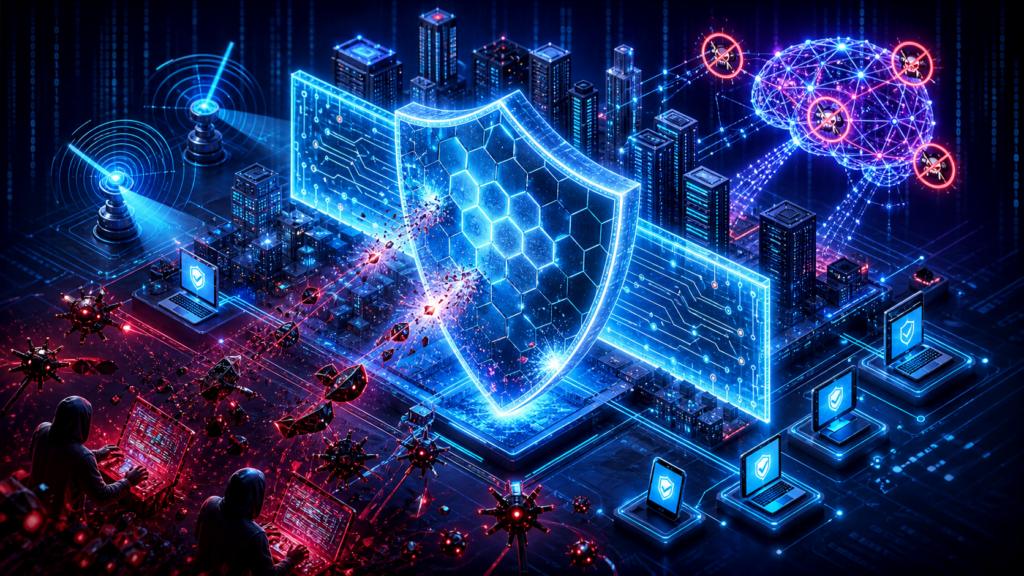
The main goal is to build a strong shield around your digital assets. This involves using various technologies and policies to prevent attacks, detect suspicious activities, and respond effectively when an incident occurs, ensuring your sensitive data remains secure.
Defining Cyber Defense for Modern Organizations
For modern organizations, cyber defense is about more than just installing a firewall. It’s a holistic and proactive approach that combines technology, processes, and people to create a resilient security posture against ever-changing threats. It requires continuous effort and adaptation.
Security teams and cyber defenders must think like the attackers they are trying to stop. This means understanding the tactics, techniques, and procedures used by malicious actors and implementing defenses that can counter them. A cyber attack is not a matter of ‘if’ but ‘when,’ and a strong defense prepares you for that reality.
Ultimately, effective cyber defense integrates security into every aspect of your information technology infrastructure. It’s a commitment to vigilance, ensuring that your organization can operate safely and confidently in the digital age, protecting both your assets and your reputation.
Key Elements and Functions of Cyber Defense Technology
Cyber defense technology is built upon several key elements that work together to form multiple layers of protection. These functions go beyond simple prevention and create a comprehensive shield against a wide range of cyber threats. Think of it as a fortress with many defensive walls.
Central to this is the use of specialized cybersecurity tools and security measures. These are not just standalone products but integrated systems that share information and work in concert. A critical component is threat intelligence, which provides insights into emerging threats and helps your team anticipate attacks before they happen.
The primary functions of cyber defense technology include:
- Prevention: Blocking potential threats before they can cause harm.
- Detection: Continuously monitoring systems to identify signs of a breach.
- Response: Taking swift action to contain and eliminate threats once detected.
- Recovery: Restoring systems and data after an attack to ensure business continuity.
- Education: Training employees to recognize and avoid security risks.
How Cyber Defense Works in Today’s Threat Landscape
In the face of constant cyber threats, a modern cyber defense operates as a continuous, cyclical process. It’s designed to be adaptive, constantly learning from new potential attacks and adjusting its defenses accordingly. This proactive stance is crucial for staying ahead of malicious actors.
For security leaders, the focus is on creating a system that not only blocks known threats but also hunts for unknown ones. This involves a dynamic incident response plan that can be activated at a moment’s notice to minimize damage and restore normal operations quickly and efficiently. Let’s explore the lifecycle and real-world applications of this process.
The Cyber Defense Lifecycle Explained
The cyber defense lifecycle is a structured approach that security teams use to manage and mitigate security risks. It’s a continuous loop of activities, ensuring that defenses are always improving. This cycle helps organize efforts and ensures no critical area is overlooked, from initial identification to post-incident recovery.
Each phase of the lifecycle builds on the last, creating a comprehensive framework for protection. For instance, the information gathered from an incident response can feed back into the protection phase, strengthening defenses against future, similar attacks. This process is often visualized using frameworks like the cyber defense matrix, which helps map tools and processes to specific defensive functions. Utilizing threat intelligence is key to making this lifecycle effective, enabling an active cyber defense posture.
Here’s how the lifecycle typically breaks down:
| Phase | Description |
|---|---|
| Identify | Understand your assets, data, and risks to know what you need to protect. |
| Protect | Implement safeguards like firewalls, encryption, and access controls to secure systems. |
| Detect | Continuously monitor your environment for suspicious activity and potential breaches. |
| Respond | Execute your incident response plan to contain, eradicate, and mitigate the impact of an attack. |
| Recover | Restore systems and data to normal operations and analyze the incident to improve defenses. |
Real-World Examples of Cyber Defense in Action
Cyber defense isn’t just a theoretical concept; it’s actively used every day across various sectors to fend off attacks. From large corporations to government agencies, effective information security strategies are critical for protecting sensitive information and maintaining operational integrity.
In the commercial sectors, for example, a retail company might use a combination of endpoint protection and network monitoring to prevent a cyber attack aimed at stealing customer credit card data. Financial institutions deploy advanced fraud detection systems that analyze transactions in real time to spot and block unauthorized activity.
Here are a few more examples:
- A healthcare provider uses access controls and data encryption to protect patient records from being compromised.
- Government agencies deploy sophisticated intrusion detection systems to guard critical infrastructure against nation-state threats.
- A tech company might use deception technology, like honeypots, to lure attackers away from real assets and study their methods.
- An e-commerce platform uses web application firewalls to prevent attacks that could take their site offline.
Cyber Defense vs. Cybersecurity: Understanding the Differences
While people often use the terms «cyber defense» and «cyber security» interchangeably, they have distinct meanings. Cyber security is a broad umbrella term that covers all aspects of protecting digital information and systems. It includes everything from policy development and risk management to user education.
Cyber defense, on the other hand, is a more focused subset of cyber security. It specifically deals with the operational and tactical measures taken to actively protect against, detect, and respond to the immediate range of cyber threats. It’s the hands-on, active part of maintaining your security posture. Let’s look closer at what sets them apart.
Core Principles That Set Cyber Defense Apart
Cyber defense distinguishes itself from broader cybersecurity through its proactive and operational focus. Rather than just setting up walls and hoping for the best, it adopts a proactive approach, actively hunting for threats and assuming that a breach is not a matter of if, but when. This mindset shift is fundamental.
This approach is guided by best practices that emphasize continuous monitoring and rapid response. One of the core principles gaining traction is zero trust, which operates on the assumption that no user or device, inside or outside the network, should be trusted by default. Every access request is verified every time. Behavioral analytics is another key principle, using machine learning to identify unusual patterns that might indicate a threat.
Here are the core principles that define cyber defense:
- Proactive Stance: Actively hunting for threats instead of passively waiting for them.
- Operational Focus: Emphasizing real-time detection, response, and recovery actions.
- Assumption of Breach: Operating with the mindset that attackers may already be inside the network.
- Continuous Improvement: Using insights from incidents to strengthen security measures over time.
When to Prioritize Cyber Defense Over Traditional Cybersecurity
While every organization needs a foundational cybersecurity program, certain situations demand a heightened focus on cyber defense. If your organization handles highly sensitive information or operates critical infrastructure, a reactive security posture is simply not enough. In these cases, the active, operational nature of cyber defense becomes paramount.
Organizations in sectors subject to strict government regulations, such as finance, healthcare, and energy, must prioritize robust defensive capabilities. The potential consequences of a breach—including massive fines and public safety risks—make an aggressive defense essential. Your cyber defense teams need the tools and mandate to actively hunt for and neutralize threats.
Ultimately, the decision to prioritize cyber defense comes down to your risk profile. If your organization is a high-value target for sophisticated attackers, or if the impact of a successful attack would be catastrophic, then your security practices must evolve from a general cybersecurity framework to a dedicated, and well-resourced, cyber defense strategy.
Main Components of Cyber Defense Technology
A strong cyber defense is not built on a single solution but is composed of several interconnected components working together. These components provide layers of protection, ensuring that if one layer fails, another is there to back it up. Key areas include prevention, detection, response, and intelligence.
From endpoint security that protects individual devices to threat intelligence that provides insight into attacker tactics, each piece is vital. Together, these cybersecurity tools and processes create a comprehensive security posture capable of defending against modern threats. We will now explore these components in more detail.
Prevention, Detection, and Response Tools
The core of any cyber defense strategy is a suite of tools designed to prevent, detect, and respond to threats. These technologies form the front line of your security operations, providing essential visibility and control over your digital environment.
Prevention tools, like firewalls and traditional antivirus software, are designed to block known threats from entering your network. They act as the first line of defense. Detection tools, such as intrusion detection systems (IDS), take this a step further by monitoring network traffic for suspicious activity that might indicate an attack in progress.
When a threat is identified, response tools come into play. These include endpoint detection and response (EDR) solutions and security information and event management (SIEM) systems, which help security teams investigate and neutralize threats quickly. Effective data security also relies on these tools to protect information at rest and in transit.
Common tools include:
- Firewalls and VPNs
- Antivirus and anti-malware software
- Intrusion Detection and Prevention Systems (IDPS)
- Endpoint Detection and Response (EDR)
- Security Information and Event Management (SIEM)
Intelligence, Automation, and Continuous Improvement
Modern cyber defense solutions are increasingly powered by intelligence and automation. Threat intelligence provides crucial context about who might be attacking you, why, and how. This information allows security teams to move from a reactive to a proactive posture, anticipating attacks before they happen.
Technologies like artificial intelligence (AI) and machine learning (ML) are transforming cyber defense. They can analyze vast amounts of data in real time to identify subtle patterns and anomalies that would be impossible for human analysts to spot. This automation frees up security teams to focus on more strategic tasks, such as threat hunting and incident analysis.
This cycle of gathering intelligence, automating detection, and responding to threats feeds into a process of continuous improvement. Each incident provides valuable lessons that can be used to refine security policies, update defenses, and make your organization more resilient. This adaptive approach is the hallmark of effective, modern cyber defense solutions.
Beginner’s Guide: Getting Started with Cyber Defense Technology
Getting started with cyber defense can feel overwhelming, but it doesn’t have to be. The key is to begin with the fundamentals and build from there. For any organization, the right starting point is to understand what you need to protect and what threats you face.
Whether you have a Chief Information Security Officer (CISO) or are just beginning to think about security, the principles are the same. You’ll need to assess your assets, choose the right security tools, and create a plan. The following sections will provide a step-by-step guide to help you build basic but effective cyber defense solutions.
Essential Resources and Skills Needed
Building a capable cyber defense requires a combination of the right people, processes, and technology. You don’t need to be a large enterprise to get started, but you do need to invest in the right areas. Having knowledgeable staff or trusted partners is crucial.
Your security teams, whether in-house or outsourced, should have a solid understanding of information technology and cybersecurity fundamentals. They need to be familiar with security best practices and be able to manage the tools you deploy. For smaller organizations, this might mean training existing IT staff or hiring specialized cybersecurity professionals.
Beyond human resources, you’ll need a clear set of processes and policies to guide your security efforts. This includes an incident response plan, data classification policies, and regular training programs. Key resources and skills include:
- Skilled cybersecurity professionals or trusted partners.
- A budget for essential security tools and training.
- Well-defined security policies and procedures.
- Support from leadership to enforce security initiatives.
Step-by-Step Guide to Building a Basic Cyber Defense
Building a basic cyber defense involves a methodical, step-by-step approach. You can’t protect everything at once, so prioritization is key. Start by focusing on the fundamentals to create multiple layers of protection around your most critical assets.
Frameworks like the Cyber Defense Matrix can help you organize your efforts, ensuring you cover all your bases from identification to recovery. For secure system design, it’s also helpful to look at established standards, such as the Center for Internet Security (CIS) Controls or compliance requirements like PCI DSS if they apply to your industry.
A basic plan should include the following steps:
- Identify and Classify Assets: Know what you have and what’s most important.
- Select and Deploy Core Tools: Implement foundational security technologies.
- Establish Processes: Create plans for monitoring, patching, and incident response.
- Monitor, Test, and Improve: Continuously evaluate and enhance your defenses.
Step 1: Identify and Classify Assets
The very first step in building any defense is knowing what you need to protect. You can’t secure your digital assets if you don’t know what they are or where they are located. This process involves creating a comprehensive inventory of all your hardware, software, and data.
Once you have an inventory, the next task is to classify these assets based on their importance to your organization. Not all data is created equal. You need to distinguish between public information and sensitive data, such as customer personal data, financial records, or intellectual property. This critical data requires the highest level of protection.
Classifying your assets helps you prioritize your security efforts and allocate resources effectively. It allows you to focus your strongest defenses on the things that matter most, forming the foundation of a strong security posture and a smart defense strategy.
Step 2: Select and Deploy Core Cyber Defense Tools
After identifying your critical assets, the next step is to deploy a set of core security tools to protect them. These tools form the technical foundation of your cyber defense solutions. Start with the essentials that provide the broadest protection.
For network security, a properly configured firewall is non-negotiable. It acts as a gatekeeper, controlling traffic in and out of your network. For endpoint security, every device that connects to your network—including laptops, servers, and mobile phones—should be protected with modern antivirus software and, ideally, an endpoint detection and response (EDR) solution.
Choosing the right security tools depends on your specific needs and budget. However, a combination of strong network security, robust endpoint protection, and regular vulnerability scanning provides a solid starting point for any organization looking to improve its defenses.
Step 3: Monitor, Test, and Improve Your Defense Strategy
Cyber defense is not a «set it and forget it» activity. The threat landscape is constantly changing, and your defenses must evolve with it. The final and most crucial step is to continuously monitor, test, and improve your defense strategy. This commitment to continuous improvement is what separates a good defense from a great one.
Monitoring your systems in real time for suspicious activity is essential for early threat detection. Tools that use behavioral analytics can help identify unusual patterns that may signal an attack. Your security teams should have clear procedures for investigating and responding to these alerts. Regular testing, such as vulnerability assessments and penetration tests, helps you find and fix weaknesses before attackers can exploit them.
This ongoing process creates a feedback loop that strengthens your security practices over time. Key activities include:
- Regularly reviewing logs and alerts from your security tools.
- Conducting periodic vulnerability scans and penetration tests.
- Updating your incident response plan based on drills and real incidents.
Conclusion
In conclusion, understanding cyber defense technology is crucial for modern organizations aiming to protect themselves against an ever-evolving threat landscape. By utilizing a combination of advanced tools, processes, and continuous monitoring, businesses can not only respond to current threats but also anticipate and mitigate future risks. Whether you are a CISO, IT manager, or business owner, implementing a robust cyber defense strategy will empower your organization to withstand cyberattacks while safeguarding sensitive data and maintaining operational integrity. To ensure you’re on the right track, consider scheduling a free consultation with our experts to explore how you can enhance your cyber defense posture today.
Frequently Asked Questions
What types of threats can cyber defense technology detect and respond to?
Cyber defense technology can detect a wide range of cyber threats. This includes malware like viruses and worms, ransomware attacks that encrypt your files, and phishing attacks designed to steal credentials. It also helps identify more sophisticated potential threats, such as insider threats and advanced persistent threats (APTs), by monitoring for unusual behavior.
Which cyber defense tools are best for small and mid-sized businesses?
For small and mid-sized businesses, it’s best to start with foundational security tools. This includes a quality firewall, modern antivirus software, and email security solutions. Adding endpoint detection and response (EDR) provides a significant boost in protection against advanced threats and helps prevent data loss without a massive budget.
How do organizations choose the right cyber defense solutions?
Organizations should choose solutions based on a thorough risk assessment. It’s helpful to use a framework like the NIST Cybersecurity Framework to identify gaps. Consulting with security professionals, considering the risk of human error, and researching solutions within the cybersecurity industry will help you make an informed decision that fits your specific needs.
What is the role of threat intelligence in cyber defense strategy?
Threat intelligence plays a critical role by providing actionable information about adversaries and their methods. It allows cyber defense teams to shift from a reactive to a proactive information security posture. By understanding current threats, like those tracked by agencies in the United States, teams can anticipate attacks and prioritize their defensive efforts.