
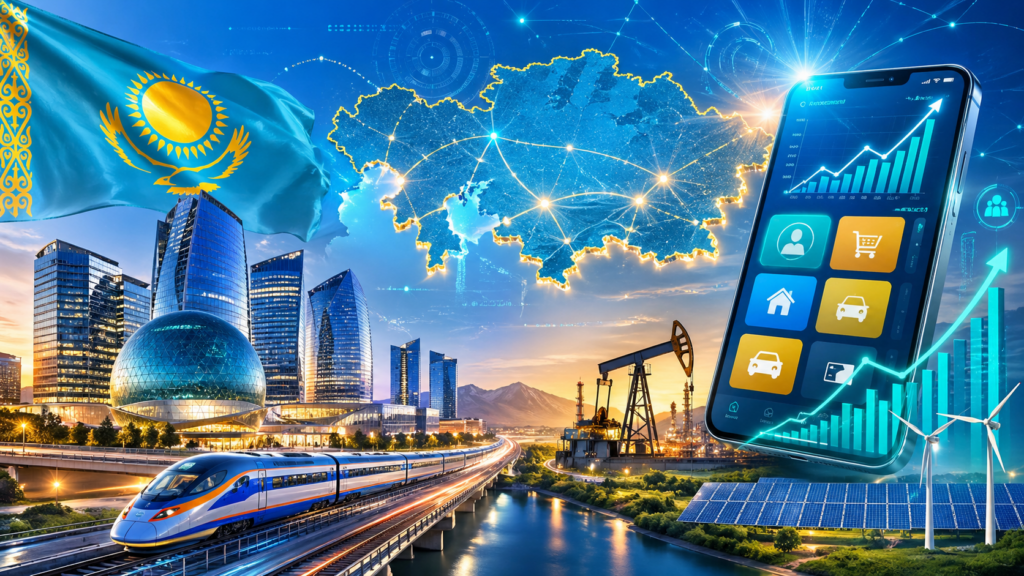
Kazakhstan has long been categorized as a frontier market, yet this label obscures the reality of a nation rapidly maturing into a significant regional economic hub. For global investors, the country represents a unique convergence of natural resource wealth, aggressive digital transformation, and a sophisticated financial regulatory environment. While many focus solely on commodity price movements, the true narrative of Kazakhstan lies in its evolution toward a services-driven, high-tech economy that is attracting increasing interest from international capital markets.
The Case for Kazakhstan: Beyond the Frontier Market Label
Central Asia’s Economic Powerhouse and the Belt and Road Initiative
 Kazakhstan’s strategic geographic position makes it a vital transit node for the Belt and Road Initiative, bridging Eastern and Western markets.
Kazakhstan serves as the linchpin of the Belt and Road Initiative (BRI) in Central Asia. Its geography—positioned between the massive consumer markets of China and the established economies of Europe—makes it a vital transit node. This position has spurred massive infrastructure investment, effectively positioning the country as a regional logistics center. By leveraging its role in land-based trade routes, Kazakhstan is transitioning from a passive exporter of raw goods to an active hub for transit services and integrated logistics.
Long-Term Growth Drivers: Education, the Torino Process, and Human Capital
Modern growth is increasingly built on human capital. Through alignment with international standards like the Torino Process, Kazakhstan is systematically upgrading its vocational and technical education systems. By investing in its workforce, the government aims to bridge the productivity gap. This focus on education ensures that as the economy shifts toward digitalization and high-value services, the labor market remains resilient and capable of supporting complex corporate structures.
The Shift from Natural Resources to a Diversified Service Economy
The Kazakh economy is undergoing a structural pivot. While oil and gas remain critical revenue streams, the focus is shifting toward banking, telecommunications, and digital finance. This diversification is the engine driving the country’s modern market growth. By moving beyond a singular reliance on natural resource price volatility, the nation is building a more robust, consumer-focused economic model that rewards long-term investors.
The Regulatory Backbone: Investing with Confidence in Central Asia
The Astana International Financial Centre (AIFC) and Common Law Framework
The AIFC is the crown jewel of Kazakhstan’s financial modernization. It operates under a unique common law framework, distinct from the civil law used in the rest of the country. This provides the predictability and legal transparency required by international institutional investors. The AIFC functions as a comprehensive security solution for capital, ensuring that disputes are settled under internationally recognized legal principles.
Comparing the Kazakhstan Stock Exchange (KASE) and the Astana International Exchange (AIX)
Investors generally interact with two primary venues: the KASE, which represents the domestic backbone, and the AIX, which focuses on international connectivity. The AIX, housed within the AIFC, was specifically designed to meet global standards for trading, settlement, and disclosure. Understanding the distinction between these two exchanges is essential for any investor, as they serve different liquidity needs and investor profiles.
The Role of Fitch Ratings in Assessing Sovereign and Corporate Stability
Credit ratings from agencies like Fitch provide the necessary validation for institutional participation. By maintaining a stable investment-grade rating, Kazakhstan reassures global markets of its fiscal discipline. This sovereign backing acts as a baseline, allowing corporate entities to issue debt and equity on global markets with greater ease and lower interest rate spreads.
Key Market Drivers: Banking, Fintech, and the «Super App» Revolution
Halyk Bank of Kazakhstan: The Pillar of Traditional Finance
Halyk Bank serves as the bedrock of the Kazakh banking sector. Its dominant market share and conservative approach to risk management make it a bellwether for the domestic economy. For international investors, Halyk represents the stable «value» component of a portfolio, offering consistent exposure to the country’s deepening financial services penetration.
Kaspi.kz and the Marketplace Platform: Redefining Digital Transactions
Kaspi.kz has become the quintessential «super app,» integrating payments, e-commerce, and fintech services into a single ecosystem. Its success is not just a triumph of technology but a reflection of the rapid adoption of digital services by the Kazakh population. As a public company, Kaspi.kz captures the rapid growth of the consumer economy, making it a focal point for those looking to tap into Kazakhstan’s digital transformation.
The Impact of Fintech Platforms on the KASE Index
The rise of fintech has fundamentally reshaped the KASE index. As these platforms dominate market activity, they exert significant influence over indices and broader investor sentiment. The performance of these companies now serves as a high-frequency indicator of domestic consumer health, reflecting the broader transition from legacy industrial reliance to modern digital commerce.
Understanding Kazakhstan ETFs and Access Vehicles
Pure-Play Exposure: The FXKZ ETF and Local Index Funds
For investors seeking targeted exposure, pure-play Kazakhstan Exchange-Traded Funds (ETFs) or specialized local index funds provide the most direct route. These instruments track the performance of the most liquid assets listed on the KASE or AIX. While liquidity can be thinner than in developed markets, these funds are the most efficient way to capture domestic growth in a single package.
Broad Emerging Market ETFs: Analyzing JPMorgan ActiveBuilders (JEMA) and Global X Strategies
Many investors gain exposure to Kazakhstan indirectly through broad emerging market ETFs. Funds like those managed by JPMorgan or Global X hold small, diversified stakes in top Kazakh companies. This strategy balances the high-growth potential of individual Kazakh assets against the safety of a global portfolio, mitigating the idiosyncratic risk associated with any single frontier market.
Sponsored GDRs and Single Stock ETFs: Bridging the Gap for Global Investors
Global Depositary Receipts (GDRs) offer a critical «bridge» for international investors. By trading on exchanges like the London Stock Exchange, GDRs allow investors to own Kazakh firms without needing direct access to domestic clearing systems. Single-stock ETFs and structured products further refine this process, allowing for more precise management of one’s investment strategy.
Thematic Opportunities: Green Bonds and Shari’ah-Compliant Investing
The Rise of Green Bond Issuance and Sustainable Finance in the AIFC
Sustainability is becoming a core component of the Kazakh financial narrative. The AIFC has championed green bond frameworks, attracting international capital interested in ESG-compliant projects. This shift highlights a modern, forward-thinking approach to sustainable finance that mirrors trends in much larger, more developed financial jurisdictions.
Navigating Shari’ah Governance Rules and Shari’ah-Compliant ETFs
The growing interest in Islamic finance has led to the development of Shari’ah-compliant investment products. These funds adhere to strict governance rules regarding interest and prohibited industries, providing an alternative path for investors who prioritize ethical compliance. This is a burgeoning segment that underscores the diversity of the Kazakh financial ecosystem.
The Tabadul Digital Exchange Hub: Regional Connectivity and Liquidity
The Tabadul digital exchange hub represents the future of regional liquidity. By connecting various exchanges in a unified digital network, it facilitates cross-border investment flows. Just as modern financial platforms employ a robust security solution to mitigate online attacks involving malformed data or malicious SQL commands, the Tabadul platform is built with high-tier electronic security to ensure that data integrity and trade execution remain bulletproof for all participants.
Technical Analysis: What Investors Need to Know Before Buying
Management Fees, Net Asset Value (NAV), and Tracking Error
When evaluating an ETF, one must look past the headlines to the technical details. The tracking error—the difference between the ETF’s return and the underlying index—is a vital metric for assessing how efficiently a manager is replicating the market. Always monitor the Net Asset Value (NAV) to ensure you are not buying at an excessive premium to the fund’s actual holdings.
Understanding Liquidity via the Central Counterparty and Clearing Sessions
Liquidity in the Kazakh market is managed through sophisticated Central Counterparty (CCP) systems. These ensure that trades are settled securely, providing a layer of protection that reduces counterparty risk. Investors should be aware of the T+2 settlement cycle, as this determines when their actions in the market result in actual ownership of the underlying securities.
Tracking the ITS Indices: The ITSS and ITSW Benchmarks
The ITS indices provide a transparent view of market health. The key word in understanding regional liquidity is «clearing,» and understanding this phrase will ensure your transactions are executed without delay. These benchmarks serve as the barometer for the broader market, helping investors time their entry and exit points effectively.
Risk Management in the Kazakh Market
Managing Exchange Rate Fluctuations and Currency Volatility
Currency risk is a reality of investing in emerging and frontier markets. While the Tenge has experienced volatility, investors can hedge their positions using currency-forward contracts or by focusing on export-oriented companies that generate revenue in hard currencies. A balanced portfolio will account for these fluctuations as part of the overall cost of investment.
Navigating Geopolitical Events and Regional Stability
Geopolitical risk is often overstated by those unfamiliar with the region, but it remains a factor to monitor. Kazakhstan’s multi-vector foreign policy has historically allowed it to maintain stable relations with major global powers. Maintaining a diversified approach helps mitigate the localized impact of sudden political or regional developments.
Diversification Strategies: Balancing Kazakhstan within a Global Portfolio
The most prudent way to invest in Kazakhstan is to treat it as a satellite component of a global portfolio. By limiting exposure to a small percentage, investors can capture the high-growth upside of the «super app» and financial sectors without over-leveraging themselves to the specific risks of a single geographic location.
How to Invest: Practical Steps for International and Retail Investors
For those ready to proceed, the process begins with selecting an appropriate broker that provides international access to the AIFC or foreign-listed GDRs. Once you have selected your provider, you must complete your account verification. Always ensure you verify all transaction receipts; if you receive an email confirmation, check the disclosure data carefully. If you require specific legal documentation regarding an ETF’s holdings, you will typically find the most updated versions at the bottom of this page on the issuer’s website.
Investors should approach the market with a long-term mindset. By focusing on the structural growth of the digital economy and the regulatory stability provided by the AIFC, you can successfully navigate the complexities of this evolving market.
Conclusion
Investing in Kazakhstan offers a unique opportunity to participate in the growth of one of Central Asia’s most dynamic economies. By moving beyond traditional frontier market labels, investors can see the potential in the nation’s fintech revolution, its robust legal infrastructure, and its strategic importance as a trade hub. Whether through broad-market ETFs or targeted exposure to leading financial platforms like Kaspi.kz and Halyk Bank, the avenues for participation are increasingly sophisticated.
The key to success lies in understanding the mechanics of the AIFC, utilizing the transparency provided by modern clearing systems, and managing currency and geopolitical risks through disciplined diversification. As Kazakhstan continues to integrate with the global economy, the barriers to entry are lowering, providing international investors with clearer pathways to growth. Conduct thorough due diligence, leverage the professional-grade data available through your broker, and maintain a focus on the long-term structural shifts driving this powerhouse economy forward. Kazakhstan represents more than just a destination for capital; it is a gateway to the next chapter of growth in the heart of Eurasia.