
Kazakhstan is frequently misunderstood by the international business community, often pigeonholed by outdated narratives that fail to capture its rapid transformation. As the largest landlocked country in the world, it serves as a critical bridge between Europe and Asia. Today, it is shedding its reputation as a mere resource-dependent economy, positioning itself instead as a sophisticated, digitally integrated regional hub. For international professionals, success in this market requires more than just capital; it demands an understanding of a culture where nomadic history converges with high-speed digital ambition. This guide provides the practical, strategic framework necessary to navigate the complexities of doing business in Kazakhstan, moving from the nuances of personal relationships to the technicalities of modern investment.
Beyond the «Stans»: Understanding Kazakhstan’s Modern Economic Identity
The Dual Reality: Nomadic Heritage Meets Digital Ambition
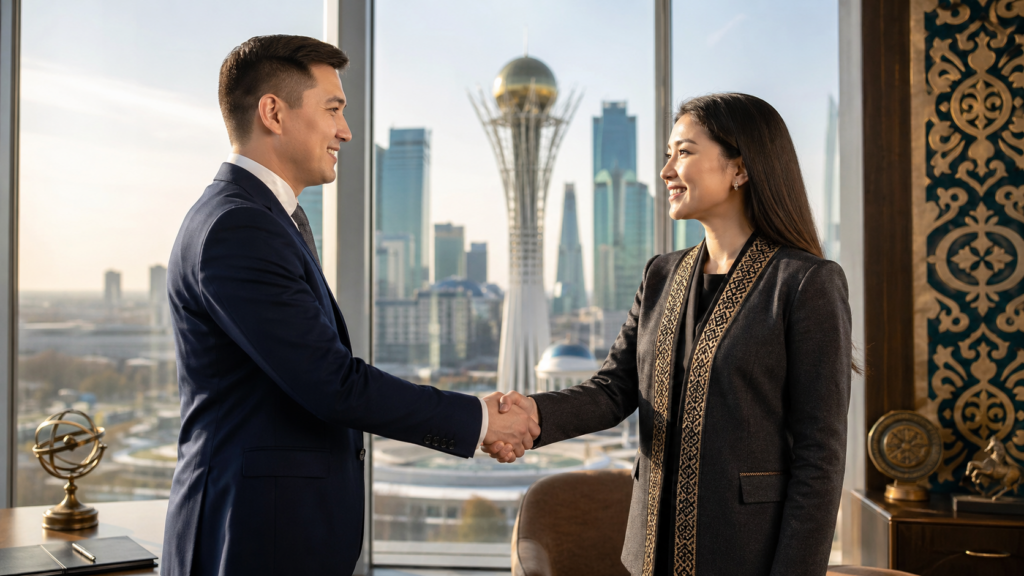
 In Kazakhstan, traditional values of hospitality and community seamlessly coexist with high-tech, modern business environments.
Kazakhstan exists in a state of fascinating flux. It is a nation that honors its nomadic traditions—values rooted in hospitality, community, and circular consensus—while simultaneously building an infrastructure designed for the 21st century. This duality is not a friction point but a defining feature of its business culture. International professionals often mistake this blend for inefficiency, but it is actually a deeply entrenched system of risk management. Understanding that modern Kazakh professionals are as comfortable in a high-tech boardroom as they are in a traditional dastarkhan setting is the first step toward building genuine rapport.
From Resource-Dependent to Innovation-Driven: The Role of Astana Hub
The shift in Kazakhstan’s economic focus is best exemplified by the Astana Hub. Moving away from total reliance on oil and gas, the government has invested heavily in creating a world-class environment for startups and international technology firms. The Astana Hub serves as a lighthouse for foreign investment, offering tax incentives, simplified visa processes, and a collaborative ecosystem that challenges the old, bureaucratic stereotypes of the region. For the global professional, this indicates a pivot: the future of doing business in Kazakhstan is not just found in the mines or the oil fields, but in the rapid digitalization of its financial and service sectors.
The Architecture of Trust: Relationship Building as Risk Management
The «Relationship-First» Approach: Why Social Capital Precedes Financial Capital
In many Western markets, business is transactional; in Kazakhstan, it is relational. You are not just closing a deal with a company; you are entering a long-term partnership with individuals. Trust is the prerequisite for financial negotiation, not the result of it. If you attempt to skip the relationship-building phase, you will likely encounter stalled negotiations. In the Kazakh mind, if they don’t know who you are and what you stand for, they cannot trust your company to deliver on its promises.
The Role of Social Gatherings and Informal Networking
Small talk is not «filler» in a Kazakh business meeting—it is the due diligence phase. Questions about your family, your journey, and your impressions of the country are opportunities for your counterparts to gauge your integrity and character. Participating in a lunch or dinner is where the real work happens. These settings allow you to demonstrate patience and respect for local norms. Engaging in these rituals is not optional; it is an investment in your own professional security.
Long-Term Partnerships vs. Transactional Interactions
While a transactional, «get-it-done-now» approach may secure a single contract, it rarely leads to the repeat business that sustains a long-term footprint in the region. Kazakh business culture values consistency and reliability. By treating a counterparty as a partner rather than a vendor, you minimize the perceived risk for them, which is the ultimate barrier to entry in this market.
Navigating the Hierarchy: Authority and Decision-Making
The Soviet-Era Legacy and its Influence on Management Styles
Legacy management structures remain, characterized by a top-down approach where decision-making is heavily concentrated at the summit. However, this is evolving. While you may notice that lower-level employees are hesitant to take initiative without explicit approval, this is not a lack of competence—it is a reflection of a corporate culture that prioritizes alignment over individual risk-taking.
Paternalistic vs. Participative Leadership: A Generational Shift
There is a clear generational divide appearing in the Kazakh business landscape. The older generation, raised in the Soviet system, often leans toward paternalistic leadership, while the younger, often Western-educated generation is pushing for more participative, agile management. Recognizing which camp your counterpart falls into allows you to tailor your communication strategy effectively.
The «Internal Discussion» Phase: How Decisions Are Actually Made
Decisions in Kazakhstan are rarely made in the boardroom during the first meeting. There is almost always an «internal discussion» phase that occurs behind closed doors after you have left. Do not be frustrated by this; respect the process. It is during this time that your influence is tested, and the relationship you built during the «tea» phase becomes your greatest asset.
Identifying the True Decision-Maker in a Meeting
The person with the highest title in the room is not always the one with the final say. Often, there is a gatekeeper or a trusted advisor—perhaps a junior associate with the ear of the boss—who holds significant sway. Always treat every member of the team with equal respect, as you never know who is providing the critical recommendation to the actual decision-maker.
Communication Nuances: The Language of Power and Diplomacy
The Linguistic Trinity: Navigating Kazakh, Russian, and English
Russian remains the lingua franca of business and industry, while Kazakh is increasingly used for official, patriotic, and cultural signaling. English is the language of the modern, internationalized tech sector. For a foreigner, learning even a few words of Kazakh shows immense respect for national identity and can instantly build rapport, even if the meeting continues in Russian or English.
Indirect Communication and Reading Between the Lines
Direct conflict is avoided to preserve «face.» If a counterpart says, «This is difficult,» they often mean «no.» Learn to read the silence and the nuance. Pushing for a blunt «yes» or «no» can be perceived as aggressive and culturally insensitive. Diplomacy is the art of allowing your counterpart to say no without embarrassment.
«Armysyz» and «Assalamualaikum»: The Etiquette of Formal Greetings
Greeting protocols matter. Using the correct titles and honorifics—or, better yet, a standard, respectful greeting in the local language—establishes a tone of humility and professionalism. It shows that you have done your homework and respect their cultural foundations.
The Professional Boardroom: Business Etiquette and Protocol
Business Card Exchange: Status and Presentation
Business cards should be treated with the utmost respect. Present your card with both hands, with the text facing the recipient. When you receive a card, take a moment to read it carefully before placing it on the table in front of you. Never shove a business card into your back pocket; it is seen as a sign of disrespect.
Punctuality and Flexibility: Managing Schedules in a Fluid Environment
You should always be on time, but be prepared for your counterparts to be late, or for a meeting to run significantly over its allotted time. This is not a sign of disrespect; it is a sign that the conversation is considered valuable. Patience is a highly regarded trait in local business culture.
The Significance of Gifts and Cultural Sensitivity
Gifts should be of good quality but not ostentatiously expensive, as this could be misinterpreted as a bribe or an attempt to create an uncomfortable obligation. Something representing your home country or culture is usually well-received as it serves as a conversation starter.
The «Tea Ceremony» Economy: Negotiations over Kazakh Cuisine
Tea Drinking and Toasting: The Rituals of the Business Lunch
Never rush the tea. It is the social glue of every meeting. If you are invited to a meal, participate fully. Toasts are common and often elaborate; they are a public expression of the relationship being built. Participate with sincerity, as these moments are often where the most significant commitments are made.
Hospitality as a Professional Competency
Hospitality is deeply ingrained in the culture. If your host is providing a banquet-style meal, they are demonstrating their respect for you. Accepting their hospitality is the primary way to reciprocate that respect. Do not turn down food or drink unless absolutely necessary; it is a vital part of the negotiation process.
Navigating the «Dastarkhan»: Table Manners and Taboos
The dastarkhan is the traditional low table where meals are served. When sitting, be mindful of your posture and how you interact with the food. There are specific customs regarding bread—never drop it or turn it upside down, as it is considered sacred. Small gestures like these go a long way in signaling that you are a serious and respectful professional.
Regional Nuances: A Country of Distinct Business Hubs
Almaty: The Cosmopolitan Financial and Lifestyle Center
Almaty is the cultural and financial heart of the country. It is the most Western-facing, vibrant, and fast-paced environment. Business here is often conducted in upscale cafes and modern offices, reflecting a lifestyle-driven culture where networking is an everyday, constant occurrence.
Astana: The Bureaucratic Heart and Policy Hub
Astana is the administrative capital. It is colder, more formal, and heavily influenced by the presence of government ministries and large state-owned enterprises. Business here requires a higher degree of formality, adherence to protocol, and an understanding of the regulatory landscape.
Shymkent and the West (Atyrau/Aktau): Energy, Trade, and Traditional Networks
The west, particularly around Atyrau and Aktau, is the center of the oil and gas industry. The culture here is more pragmatic and industrial, often revolving around the realities of large-scale extraction projects. Meanwhile, Shymkent in the south is known for its strong traditional networks and trading history. Adapting your approach to these specific regional contexts is vital for long-term success.
The Legal and Digital Landscape for International Professionals
Kazakhstan offers various legal structures, such as Limited Liability Partnerships (LLPs) and Special Economic Zones (SEZs), which provide favorable conditions for foreign investors. Furthermore, the introduction of the «Neo Nomad» visa and other digital-friendly policies signals a maturing environment for international consultants, developers, and entrepreneurs. Leveraging these legal frameworks, while keeping a firm grasp on the cultural nuances discussed, provides a balanced, low-risk, and high-reward strategy for market entry.
Conclusion
Doing business in Kazakhstan is an exercise in balancing structure with nuance. While the legal and economic frameworks are rapidly modernizing to compete on a global stage, the core of the business culture remains anchored in human relationships, patience, and mutual respect. To succeed as an international professional, one must move past the superficial «exotic» stereotypes and engage with the country on its own terms.
The path to success involves three primary pillars:
- Relationship-First Strategy: View social interaction not as a delay, but as the essential due diligence process that precedes every major contract.
- Contextual Adaptability: Recognize that the pace of business in Almaty differs from the formal, policy-driven environment of Astana, and tailor your approach accordingly.
- Cultural Intelligence: Demonstrate respect for the local traditions—the tea ceremonies, the linguistic history, and the hierarchies—which, when mastered, serve as your greatest competitive advantage.
By bridging the gap between your own professional background and the unique, consensus-driven culture of Kazakhstan, you move from being a temporary visitor to a trusted partner. The country is currently in a state of ambitious transition, and for those who arrive with the right mindset, the opportunities to grow alongside this dynamic nation are substantial. Prioritize clarity in your legal dealings, patience in your negotiations, and authentic engagement in your social interactions, and you will find that the Kazakh market is as rewarding as it is unique.